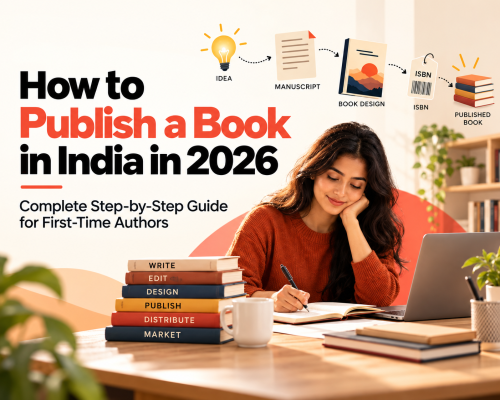
A complete step-by-step guide for first-time authors who want to turn their manuscript into a professionally published book.
Publishing your first book can feel exciting and confusing at the same time. You may have completed your manuscript, or perhaps you are still working on it, but sooner or later the same questions appear: What happens next? How do I publish it? Do I need an ISBN? Who designs the cover? How will readers find the book?
The good news is that publishing a book in India is much more accessible today. You do not need to understand the entire publishing industry before you begin. You simply need to understand the process one step at a time.
Every book begins with an idea, but a publishable book needs a little more clarity. Before worrying about printing, ISBNs or Amazon listings, understand what you are trying to create.
A clear purpose makes everything easier later, including the title, cover design, description, category and marketing.
Your first draft does not need to be perfect. It simply needs to be complete.
Many first-time authors spend too much time correcting every sentence while they are still writing. This often slows the book down. Finish the story or subject first. Refinement can come later.
Writing creates the book. Editing makes it ready for readers.
Even a strong manuscript may contain repetition, unclear sentences, grammar problems or sections that need better structure. A careful editing process improves both the book and the reader's experience.
Remove repetition and improve weak or unnecessary sections.
Improve grammar, spelling, punctuation and sentence flow.
Give the final book one last careful check before publishing.
There is no single publishing model that is right for every author. Your decision should depend on your goals, budget, timeline and how much control you want.
A publisher selects the manuscript and manages the publishing process. Selection can be competitive and the process may take longer.
The author manages or funds the process and usually has greater control over the book, pricing and publishing timeline.
Professional publishing support is provided for services such as editing, design, ISBN, formatting, printing and distribution.
Once the manuscript is ready, attention shifts from writing to presentation.
| Book Title | Clear, memorable and suitable for the subject. |
| Subtitle | Useful when the main title needs more explanation. |
| Description | Helps readers understand why they should read the book. |
| Author Bio | Introduces the person behind the book. |
Readers often see the cover before they read a single sentence. A professional cover should match the genre, remain readable at thumbnail size and create the right expectation about the book.
Avoid overcrowding the cover with too many fonts, images or ideas. Simple and thoughtful design usually creates a stronger impression.
Good formatting should almost disappear while the reader is reading. It should feel comfortable, balanced and professional.
An ISBN gives a book its unique publishing identity and helps with cataloguing and distribution. The publishing setup also includes details such as the copyright page, MRP, barcode, categories and book metadata.
Accessible, practical and suitable for most first-time authors.
A premium option for gift editions, special releases and selected titles.
Convenient for digital readers and useful for wider online accessibility.
A printed book has achieved one milestone. The next challenge is helping readers find it.
A good book does not automatically find its audience. Readers need opportunities to discover it.
Book marketing does not mean repeatedly asking people to buy. Good marketing gives people a reason to become interested in the book and the person behind it.
Your first book can introduce you to readers, but your author identity gives them a reason to stay connected. Build your profile slowly through meaningful writing, useful ideas and genuine interaction.
There is no fixed timeline because every manuscript begins at a different stage. A complete and edited manuscript can move through production relatively quickly, while a book that still needs significant editing or design work naturally takes longer.
A useful rule: do not rush the book simply to publish it sooner. Readers will remember the quality long after they forget the launch date.
Publishing cost depends on the book itself. A poetry collection, novel, children's book and academic title may all require different levels of editing, design, printing and production.
Instead of looking only for the lowest price, compare what the publishing package actually includes and what level of quality and support you will receive.
You do not need to understand everything about publishing before you begin. Start with your idea, complete the manuscript, improve it carefully and take each publishing decision with clarity.
Your first book is not simply a product. It can be the beginning of your journey as an author.
Yes. First-time authors can choose traditional publishing, self-publishing or assisted publishing depending on their requirements.
An ISBN is strongly recommended for professional publication, cataloguing and book distribution.
Yes. Books can be published in English, Hindi and many other Indian languages.
For many books, offering both formats is useful because it gives readers more choice.
Yes. Good editing improves clarity, readability and the overall credibility of the finished book.

Blog Comments