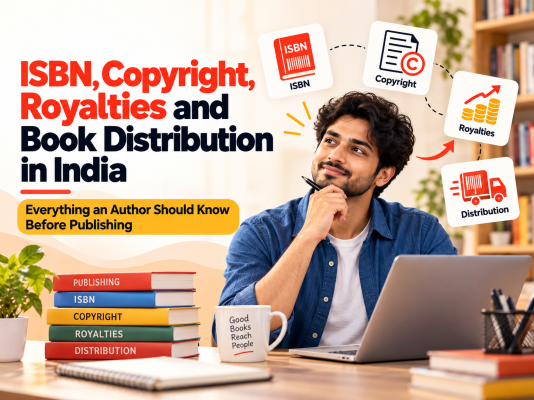
Everything an Author Should Know Before Publishing
A clear and practical guide to four publishing terms every author should understand before signing an agreement or releasing a book.
Writing a manuscript is creative. Publishing it also involves a few business and legal decisions.
Terms such as ISBN, copyright, royalty and distribution often appear in publishing proposals and agreements. Yet many first-time authors sign documents without fully understanding what these words mean.
You do not need to become a publishing expert. But you should know enough to understand what belongs to you, how your book will be identified, how you may earn from sales and where the book can actually reach readers.
ISBN stands for International Standard Book Number. It is a unique identifier used by publishers, booksellers, libraries, distributors and book databases to identify a publication.
In India, ISBN administration is handled by the Raja Rammohun Roy National Agency for ISBN under the Ministry of Education. Authors, self-publishers, publishers, institutions and other eligible applicants can apply through the official Indian ISBN system.
If you are publishing through a publishing house, the publisher may handle the ISBN process as part of the publishing package.
ISBN and copyright are completely different. An ISBN identifies a publication. It does not prove that you created the manuscript or automatically determine who owns the copyright.
Copyright protects original creative expression, including literary works such as books.
Under Indian copyright law, copyright generally comes into existence automatically when an original work is created. Registration is not required simply for copyright to exist.
As a general rule, the author is the first owner of copyright in a literary work, subject to exceptions under law and any valid agreement or assignment.
This is why authors should read publishing agreements carefully. A publishing agreement may grant certain publishing rights to a publisher without necessarily transferring complete ownership of the copyright.
Registration is optional in India. Copyright exists automatically when the qualifying original work is created.
However, the Copyright Office states that a registration certificate and entries in the Register of Copyrights can serve as prima facie evidence in disputes concerning copyright ownership.
Do not assume that every publishing agreement uses the same terms.
A royalty is the amount an author becomes entitled to receive under the publishing or platform agreement when qualifying book sales occur.
There is no single universal royalty percentage for every book in India. The calculation depends on the publishing model, platform, format and agreement.
Authors should always ask what the royalty percentage is calculated on.
Imagine a book has an MRP of Rs. 300.
A royalty calculated as a percentage of MRP will work differently from a royalty calculated after retailer discounts, printing costs, taxes, returns or marketplace deductions.
Before comparing royalty percentages, compare the calculation method.
Publishing platforms may use their own royalty structures. For example, Amazon KDP currently provides 35% and 70% royalty options for eligible eBooks, with the 70% option subject to pricing, territory and other conditions.
Print royalty calculations can also involve printing costs and marketplace-specific rules, so authors should review the current terms of the platform they use.
Distribution means making a book available through channels where readers, retailers or libraries can order it.
This may include online marketplaces, bookstores, wholesalers, libraries, publisher websites and direct sales channels.
Distribution can make the book available for order. It does not automatically create reader demand.
Availability puts the book on the shelf. Marketing gives readers a reason to notice it.
Marketplaces and online booksellers where readers can order books directly.
Physical retail channels where suitable titles may be stocked or ordered.
Sales through publishers, authors, events or dedicated websites.
Print-on-demand, often called POD, is a model where copies can be printed as orders are received rather than requiring a large quantity to be printed and stored in advance.
It can reduce inventory risk, although the cost per individual copy may differ from larger bulk print runs.
Some distribution services connect book metadata and availability with networks of retailers, libraries and online stores.
For example, IngramSpark states that its distribution network connects titles with more than 45,000 retailers, libraries and online stores internationally.
However, being available in a distribution catalogue does not mean every bookstore will physically stock the title.
ISBN, copyright, royalties and distribution may sound technical, but each one answers a very practical question about your book.
Know who owns the rights. Understand how you will be paid. Know where the book will be available. And read every agreement before you sign it.
A well-informed author makes better publishing decisions.
No. ISBN identifies a publication, while copyright relates to legal rights in an original work.
No. Copyright generally arises automatically when an original qualifying work is created. Registration is optional, though it can have evidentiary value.
No. Royalty percentages, calculation methods, deductions and payment schedules depend on the publishing agreement.
No. Distribution can make a title available to ordering channels, but actual stocking decisions depend on retailers, demand and distribution arrangements.
Check copyright ownership, rights granted, contract duration, royalty calculation, payment terms, formats, distribution channels and termination conditions.

Blog Comments