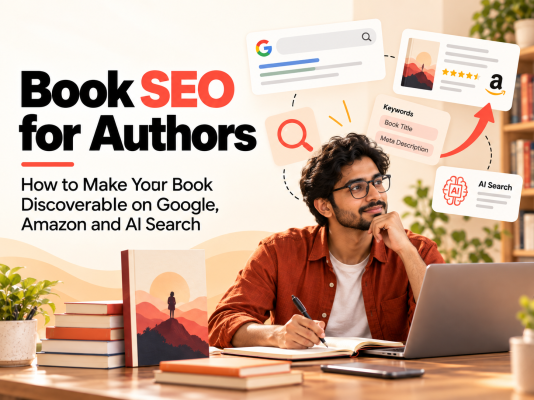
How to Make Your Book Discoverable on Google, Amazon and AI Search
A practical guide to helping readers find your book when they search by topic, genre, problem, interest or recommendation.
A book can be beautifully written, professionally designed and available online, yet still remain difficult to discover.
This usually happens because availability and discoverability are not the same thing.
Availability means your book exists on a website or marketplace. Discoverability means the right reader can actually find it when searching for something related to your book.
That is where book SEO becomes useful.
Book SEO means organizing your book information and online content so search systems can understand what your book is about and show it to relevant readers.
In simple words: use the language your readers use when they search.
Helps readers discover web pages, articles, author websites and book information through search queries.
Helps shoppers discover books through title information, keywords, categories, sales signals and listing relevance.
Can surface useful public pages and sources when answering questions about books, topics, authors and recommendations.
Before choosing keywords, ask what your reader is actually trying to find.
A reader may not know your name or your book title. They may only know the problem, subject or genre they are interested in.
These search phrases reveal what readers want. Your SEO should help connect your book with those needs.
Your main keywords should describe the subject, genre, audience or benefit of your book.
Avoid choosing keywords only because they appear popular. A keyword is useful only when it genuinely matches the book.
Broad keywords can be difficult because they may describe thousands of unrelated books.
| Too Broad | More Useful |
|---|---|
| Self-help | Self-confidence book for young adults |
| Romance | Contemporary Indian romance novel |
| Business | Small business guide for beginners |
| Poetry | Hindi poetry on love and relationships |
Google needs clear public pages that explain your book, your name and the subjects connected to your writing.
A strong website presence gives search engines more useful information than a marketplace listing alone.
Each important book should have its own clear page on your author or publisher website.
A book page can rank for the title, but articles can help you reach people who are searching for the subject before they even know your book exists.
If you write a book about productivity, for example, you can publish articles answering common productivity questions. Relevant readers may discover the article first and the book second.
This makes blogs useful for both reader education and long-term book discovery.
Search engines and readers both benefit from clear headings.
Avoid clever page titles that hide the actual subject. Say clearly what the page is about.
Amazon uses book information, keywords, categories and other signals to decide where a book may appear. Relevant metadata helps place the book in front of more suitable shoppers.
Amazon KDP currently allows authors to add up to seven keyword fields or short phrases for a title.
Use those fields for useful details that are not already fully covered elsewhere in your metadata.
Categories are like digital bookstore shelves. They help Amazon understand where your book belongs and help readers browse books that match their interests.
Choose categories that genuinely describe your book. Do not place a book in an unrelated category simply because you think it will be easier to rank there.
Relevance creates a better reader experience and usually produces better-quality discovery.
The title on your listing should match the actual title on the book cover. Author name, description and edition details should also remain accurate.
Avoid adding promotional claims, unrelated author names or misleading phrases simply to attract searches.
AI search systems often answer questions by finding and summarizing useful public information from the web.
Clear, factual and accessible information gives these systems a better chance of understanding your book correctly.
If basic information about your book is hidden only inside images, private pages or closed platforms, search systems have less useful text to understand.
AI search is often question-driven. People ask complete questions instead of typing only two or three keywords.
This makes useful FAQ sections, explanatory articles and detailed book pages especially valuable.
Search systems cannot properly understand a public page if they are blocked from accessing it.
For AI discovery specifically, publishers should review whether relevant search crawlers are allowed to access public website content.
This is mainly a technical website setting, so authors working with a publisher or web developer may need help checking it.
Your website, Amazon listing, publisher page and author profiles should not tell different stories about the same book.
Search visibility becomes stronger when an author's name appears consistently alongside useful and relevant information.
Author interviews, guest articles, event pages, publisher profiles and thoughtful content can all help create a clearer online identity.
Over time, readers may begin searching for the author's name directly instead of only searching by subject.
Search behaviour changes. Book positioning can change. New reader questions appear.
Review your book pages, descriptions, keywords and related articles from time to time. Improve anything that is unclear, outdated or no longer useful.
SEO works better as an ongoing publishing habit than as a one-time task.
Google needs to understand your pages. Amazon needs to understand your book metadata. AI search needs clear public information it can interpret and cite.
But behind all three systems is the same person: a reader searching for the right book.
Write for readers first, organize the information clearly, and make discovery easier everywhere your book appears.
Book SEO is the process of making book information clear and relevant so readers can discover it through search engines, marketplaces and other search-based platforms.
Yes. Relevant keywords can help Amazon understand the content of a book and connect it with appropriate reader searches.
A website is not the only way to be discovered, but it gives authors and publishers a useful place to publish detailed book pages, articles and accurate author information.
Publicly available book pages and related content may be surfaced when an AI search system finds them relevant to a user's question.
There is no fixed timeline. Search visibility depends on competition, relevance, content quality, website access, marketplace signals and how consistently the book is presented online.

Blog Comments